

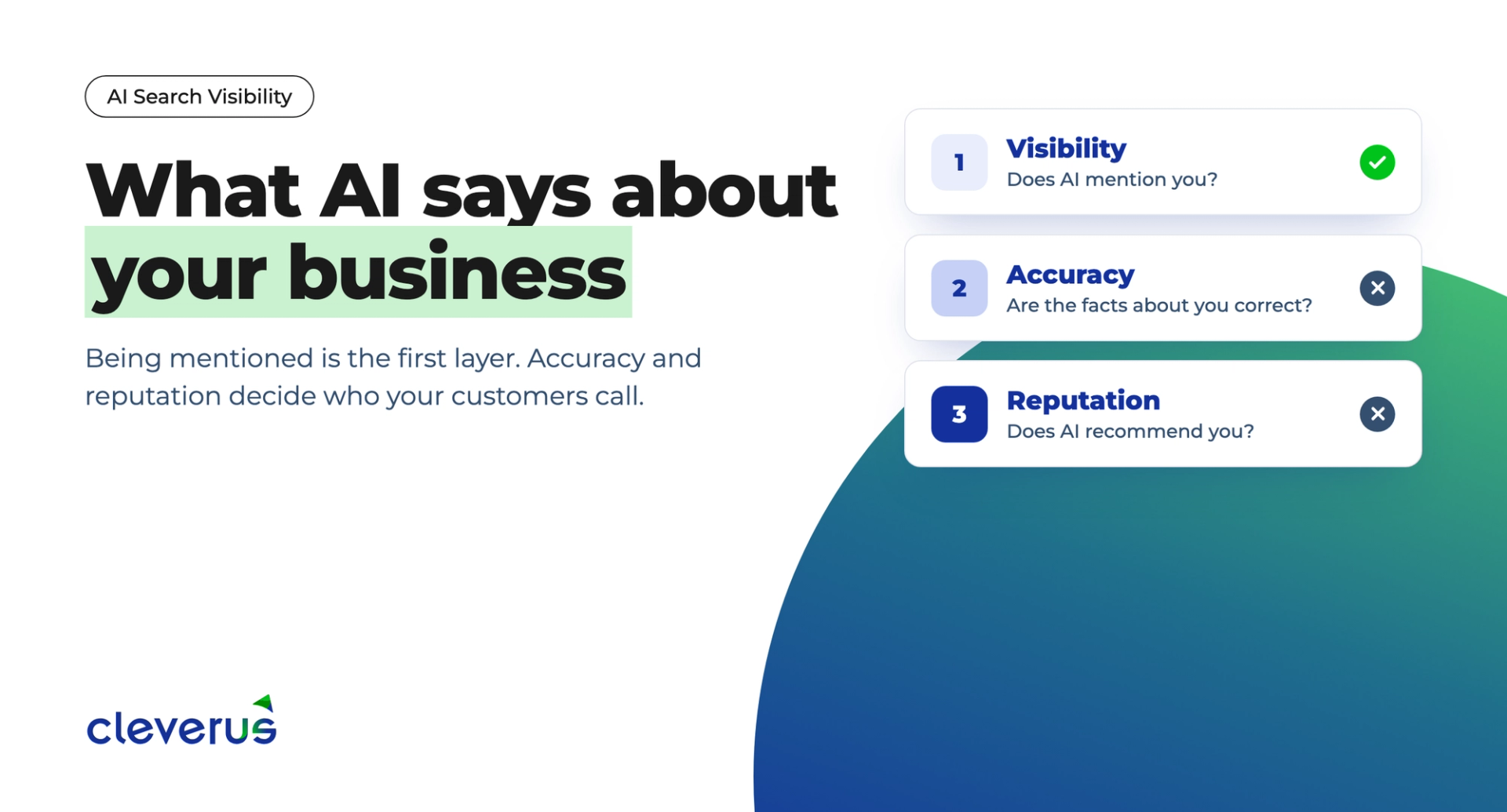
What AI says about your business comes down to three layers, visibility, accuracy and reputation. Three in four Malaysian digital consumers have used generative AI tools, according to Google's e-Conomy SEA 2025 report, so each layer shapes who your customers call.
Most AI visibility checks ask one thing, whether ChatGPT, Gemini or Google's AI Overview mentions your business. A mention is only the first layer. The answer also needs to get your facts right and describe your business in a way that earns the customer's trust.
This article explains each layer, the accuracy and reputation risks most owners never see, and a simple way to score the answers AI gives about you.
Why AI Search Visibility Is Only the First Layer
A mention in an AI answer looks like a win, but customers act on everything around it. An AI tool can name your company, then give an old phone number, describe a service you stopped offering, or recommend a competitor in the very next sentence.
Fewer people click through to check. In a study of real browsing behaviour, the Pew Research Center found that Google users who saw an AI summary clicked a traditional search result in 8% of visits, compared with 15% for those who didn't see one. The AI answer is often the only description of your business a customer reads before deciding.
The Three Layers of What AI Says About Your Business
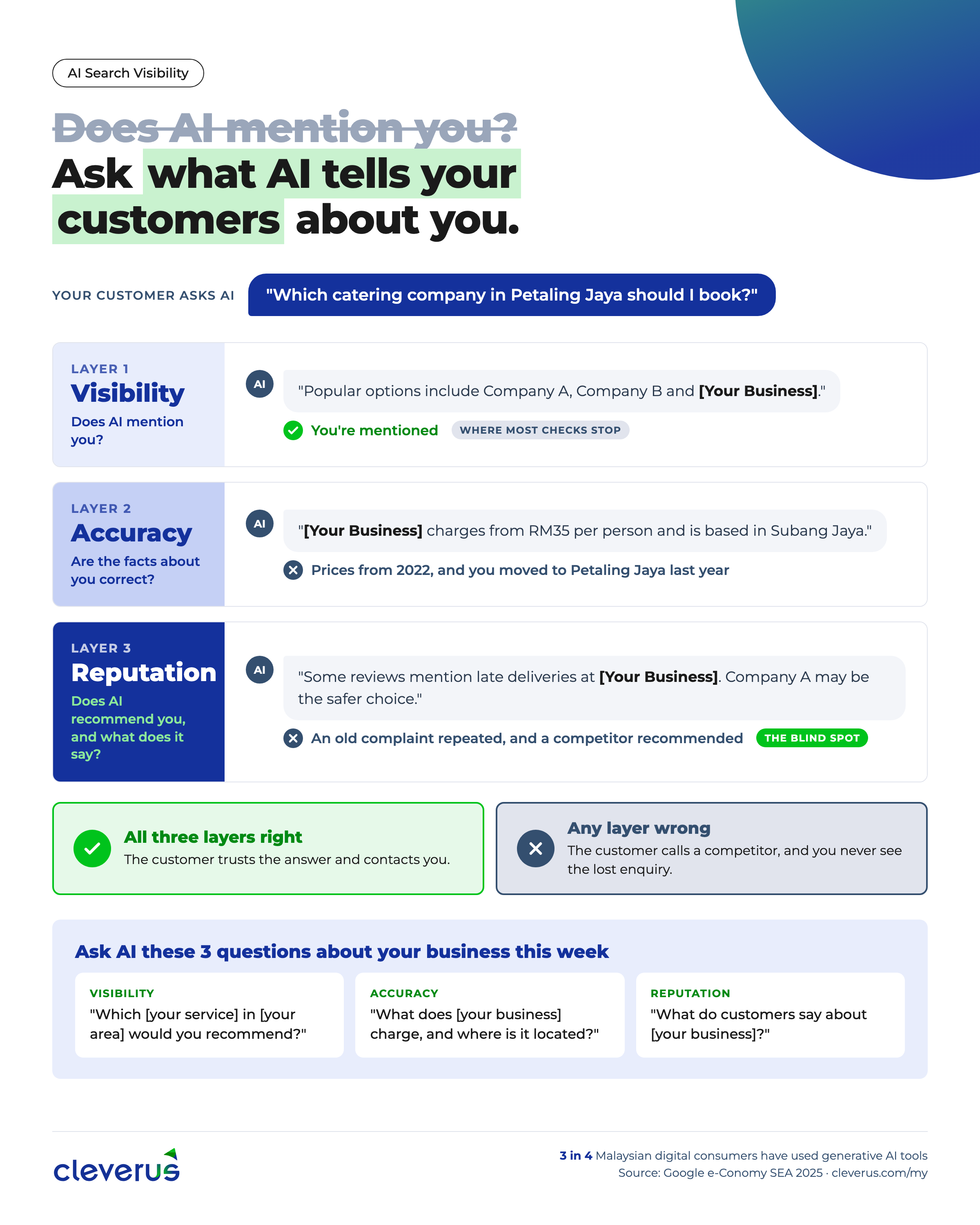
Every AI answer about your business can be judged on three layers. Each one affects whether the customer contacts you.
| Layer | The question | What goes wrong |
|---|---|---|
| Visibility | Does AI mention you? | You're missing from answers about your service |
| Accuracy | Are the facts about you correct? | Old prices, wrong address, retired services |
| Reputation | Does AI recommend you, and how does it describe you? | Competitors recommended, negative comments repeated |
Visibility
Visibility is whether you appear at all when customers ask about your type of service in your area. It's the layer most businesses track, and the easiest to measure. The steps in how to rank in AI-generated answers help with this layer.
Accuracy
Accuracy is whether the facts in the answer are right. AI tools still make frequent mistakes. A study coordinated by the European Broadcasting Union and led by the BBC found that 45% of AI answers about news content had at least one serious issue, and 20% contained major accuracy problems, including invented details and outdated information. The same weaknesses show up in answers about businesses, often through old pages, outdated directory listings and conflicting contact details.
Reputation
Reputation is how the answer positions you. An AI tool can mention you and still steer the customer elsewhere, by recommending a competitor first or repeating an old complaint about your service that was resolved long ago.
When AI Gets Your Facts Wrong, Your Business Takes the Blame
An AI tool that gives a wrong fact about you never has to face the customer. The customer acts on the answer, and the consequences land on your business. Picture a customer who turns up at a branch that closed last year, expects a promotion that ended in 2024, or asks for a refund policy you never offered.
Wrong AI answers often turn into problems like these:
- customer service complaints from people who were given the wrong price, hours or location
- arguments at the counter or over WhatsApp when your staff correct what the AI said
- refund or price disputes based on terms your business never set
- negative reviews written about your business, even though the AI made the mistake
- lost trust and lost sales from customers who decide you're unreliable
Your business may not be legally responsible for a mistake an AI tool makes. The customer still experiences it as your mistake, and the impact falls on your brand, your team's time and your reviews. Research on how customers react to wrong AI answers is covered in what AI is telling your customers about your brand.
The Reputation Blind Spot in AI Answers
Reputation is the layer most owners never see. A customer asks an AI tool privately, reads the answer and makes a decision. No alert reaches you, no review appears on your page, and the enquiry simply never arrives.
The reputation problems that show up in AI answers include:
- a competitor recommended ahead of you for a service you provide
- old complaints or a single bad review repeated as if they were current
- negative comments about your product, service or brand drawn from forums and social media
- descriptions that make your business sound smaller or less established than it is
These answers turn into business risk over time. Lost enquiries are hard to trace, so falling leads look like a slow market instead of a reputation problem. Each AI tool can also repeat the same description to thousands of customers, so one outdated complaint keeps hurting your reputation long after it was resolved.
How to Score What AI Says About Your Business
A simple monthly scorecard shows how your business performs on all three layers. Ask ChatGPT, Gemini, Copilot and Perplexity the questions your customers ask, in the languages they use, then score each answer.
| Layer | Score the answer on | Good result |
|---|---|---|
| Visibility | Are you named for general questions about your service and area? | Named in most answers |
| Accuracy | Are the price, location, hours and services correct? | Every fact matches your records |
| Reputation | Is the tone positive, and who gets recommended first? | Positive tone, recommended first or alongside |
Malaysian customers ask in English, Bahasa Malaysia, Chinese and a mix of all three, and each language can draw on different sources. Score the answers in each language your customers use, and note the pages the tools cite, since those pages are where wrong or negative information usually comes from.
How to Improve What AI Tells Customers About You
You can't edit an AI answer directly, but you can improve the information it draws from. AI tools build answers from your website, business listings, reviews and other pages that mention you. Read more on how AI tools choose their sources.
Your Website
Keep one clear page for each service, and state your locations, prices and contact details in plain text. Remove or update old promotion pages. Add schema markup, the code that labels your business name, address and services for search engines, so AI tools read those details correctly.
Business Listings
Update your Google Business Profile first, then directories and marketplace listings. The same name, address and phone number everywhere help AI tools match the details to the right business.
Reviews and Reputation
Reply to reviews, including negative ones, and show how each issue was resolved. Encourage happy customers to mention the specific service they used and your location. Recent, detailed reviews give AI tools a current picture of your business to repeat.
Third-Party Mentions
News articles, partner pages and industry directories carry weight with AI tools. Ask partners to update old details, and offer them a short, accurate company description they can copy word for word.
Managing What AI Says About Your Business
AI search visibility gets your business into the answer. Accuracy and reputation decide whether that answer sends the customer to you or to a competitor. A monthly scorecard across all three layers, clean sources and an active approach to reviews give AI tools the right picture of your business to repeat.
Cleverus helps Malaysian businesses track and improve what AI tools tell customers about them through its Generative Engine Optimisation (GEO) service. Visit Cleverus to learn more about checking what AI says about your business.
References
- Google Malaysia. (2025). e-Conomy SEA Report 2025: Malaysia's Digital Economy. Available at: https://blog.google/intl/en-my/company-news/around-the-globe/2025_11_e-conomy-sea-report-2025-malaysias/
- Chapekis, A. and Lieb, A. (2025). Google Users Are Less Likely to Click on Links When an AI Summary Appears in the Results. Pew Research Center. Available at: https://www.pewresearch.org/short-reads/2025/07/22/google-users-are-less-likely-to-click-on-links-when-an-ai-summary-appears-in-the-results/
- European Broadcasting Union. (2025). Largest Study of Its Kind Shows AI Assistants Misrepresent News Content 45% of the Time. Available at: https://www.ebu.ch/news/2025/10/ai-s-systemic-distortion-of-news-is-consistent-across-languages-and-territories-international-study-by-public-service-broadcaste