
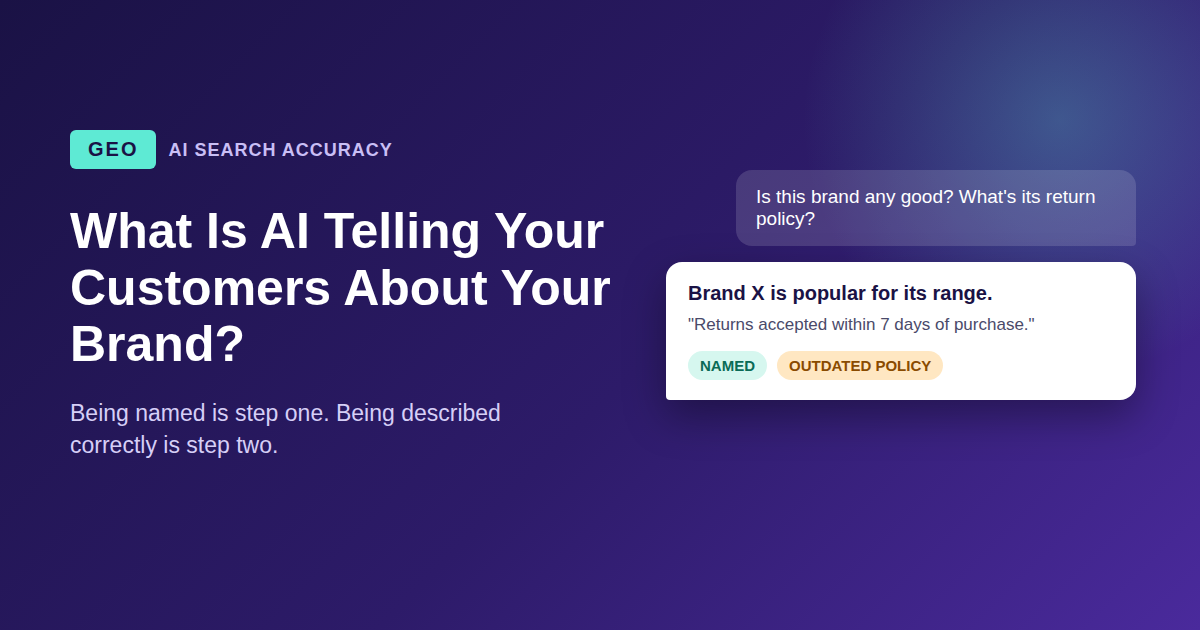
The Edge Malaysia reported this week on a panel at the Alliance Bank BizSmart Business Conference (ABBBC2026), where our Head of Business Growth, Lawmence Wong, was one of the speakers. The story covers SMEs being urged to improve their search visibility as consumers shift to AI-generated searches. Lawmence added a point we think deserves its own post. He said that being named by AI is only half the job, because what the answer says about you is the other half.
We agree with him, and this post is our take on why. Visibility still comes first, but for brands people already know, accuracy is where the reputation is won or lost.
Last updated 7 October 2026.
Why Do Customers Ask AI About Brands They Already Know?
People used to type a brand name into Google and click through a few pages. Many now skip that and ask AI directly. Is this brand any good? How does it compare with the other one? What is its return policy? The Edge Malaysia's report on the panel describes the same shift, with consumers moving from traditional searches to AI-generated ones when they research products and services.
For an established brand, that changes the question. Customers already know your name, so the worry is no longer whether they have heard of you. It is what they hear when they ask.
Open ChatGPT tonight and ask about your own brand the way a customer would. You may not like the first answer.
Is Being Mentioned by AI Enough for Your Brand?
No, but it still comes first. If AI never names you, customers compare the brands it does name, and you lose before the conversation starts. Getting cited is the first job of any GEO plan. Our post on how AI tools choose their sources explains what decides who gets named.
Visibility alone doesn't close the sale, though. On the panel, Lawmence described a furniture company that showed up in AI results while the AI recommended its competitors. Being in the answer and being the one recommended are two different results.
He summed it up in one line, as The Edge reported it:
it's not really about AI mentioning you only; it's whether AI mentioned your information accurately.
We'd go a step further. In our view, visibility gets you into the conversation and accuracy decides what customers do next. A brand that's named with the wrong price, an old policy or a discontinued product has paid for attention it can't use.
What Happens When AI Gets Your Brand Wrong?
Most of the time, you will never hear about it.
A customer asks AI about your return policy, gets last year's version and decides the process looks painful. They don't email you or leave a review. They buy from someone else, and your sales report shows nothing unusual. Some customers do complain, which at least gives you a chance to fix things. The silent ones are the problem.
There is early survey data on how people react. A Dynata survey for Skyword of 1,000 US adults in April 2026 found that 17% had switched brands and 19% had avoided a purchase because of what AI said about a brand. When AI and a brand's own information disagreed, 54% checked another source, 29% trusted the brand and 12% trusted the AI outright. It's a US sample, so treat the percentages as a direction for Malaysia, not a measurement of it.

Look at who is in that 54%. They check on review sites, forums and news pages that you don't control. And the 12% who accept the answer don't check at all. Neither group tells you what they saw.
Where do wrong answers come from? Lawmence shared that an e-commerce company found AI tools surfacing outdated return policies from third-party sources. It fits how these tools work. In a Stanford HAI audit of six chatbots on news questions, retrieval failures caused 38.8% of the errors. News isn't brand information, but the pattern is the same, because the answer is only as current as the page the tool picked up.
If your policy changed last year, find every page where the old version still lives.
How Can I Check What AI Says About My Brand?
You don't need a tool for a first check. An hour and a spreadsheet will do.
- Write five questions a customer would ask about you, such as "Is [your brand] good for families?", "What is [your brand]’s return policy?" and "[Your brand] or [competitor]?"
- Ask each question in ChatGPT, Gemini and Perplexity, in English and in Bahasa Malaysia.
- Mark every answer. Were you named? Was the information correct? Did it recommend a competitor instead?
- Open the sources the answer cites and find the page that gave the wrong detail.
- Fix that page first if it's yours. If it belongs to someone else, ask for a correction.
- Run the same questions again every month, and after any change to prices, policies or opening hours.

Give one person ownership of this. In our view, fixes get lost when marketing assumes customer service has it, and customer service assumes marketing does. Whoever owns your website content is usually the right choice.
If you'd like a hand, our GEO service covers both sides, getting named and getting named correctly.
If you're not sure what AI says about your brand and need help, feel free to contact us at Cleverus to schedule a consultation.
References
The Edge Malaysia. (2026). SMEs urged to improve search visibility as consumers shift to AI-generated searches. Available at: https://theedgemalaysia.com/node/820690.
Yahoo Finance. (2026). When AI Gets Brand Information Wrong, Consumers Look Beyond the Brand (Dynata survey for Skyword, April 2026). Available at: https://finance.yahoo.com/sectors/technology/articles/ai-gets-brand-information-wrong-130000420.html.
Stanford HAI. (2026). Reading Today's Headlines Through AI: A Real-Time Audit of Six Commercial Chatbots. Available at: https://hai.stanford.edu/news/reading-todays-headlines-through-ai-a-real-time-audit-of-six-commercial-chatbots.