


If you’ve been keeping up with SEO trends or looking for ways to sharpen your digital marketing strategy, you’ve probably seen terms like Answer Engine Optimization (AEO). Dig a little deeper this year, and you’ll likely spot another buzzword making waves: Generative Engine Optimization (GEO). As AI-powered platforms become the go-to for instant answers, marketers are shifting focus from simply ranking on Google to making their content the answer, wherever users search.
Yet, this space is so new, even industry experts haven’t settled on a common vocabulary. Agencies, publishers, and SEO specialists have coined a range of acronyms, AEO, GEO, GSO, and more to describe the same trend: making sure AI crawlers can easily understand and feature your brand in synthesized answers.
So, what’s the real difference between AEO and GEO? In practice, they’re two names for the same mission, to help your brand stand out in an AI-driven world. Let’s break down what these terms mean, why they matter, and how you can future-proof your content strategy.
What is Answer Engine Optimization (AEO) ?
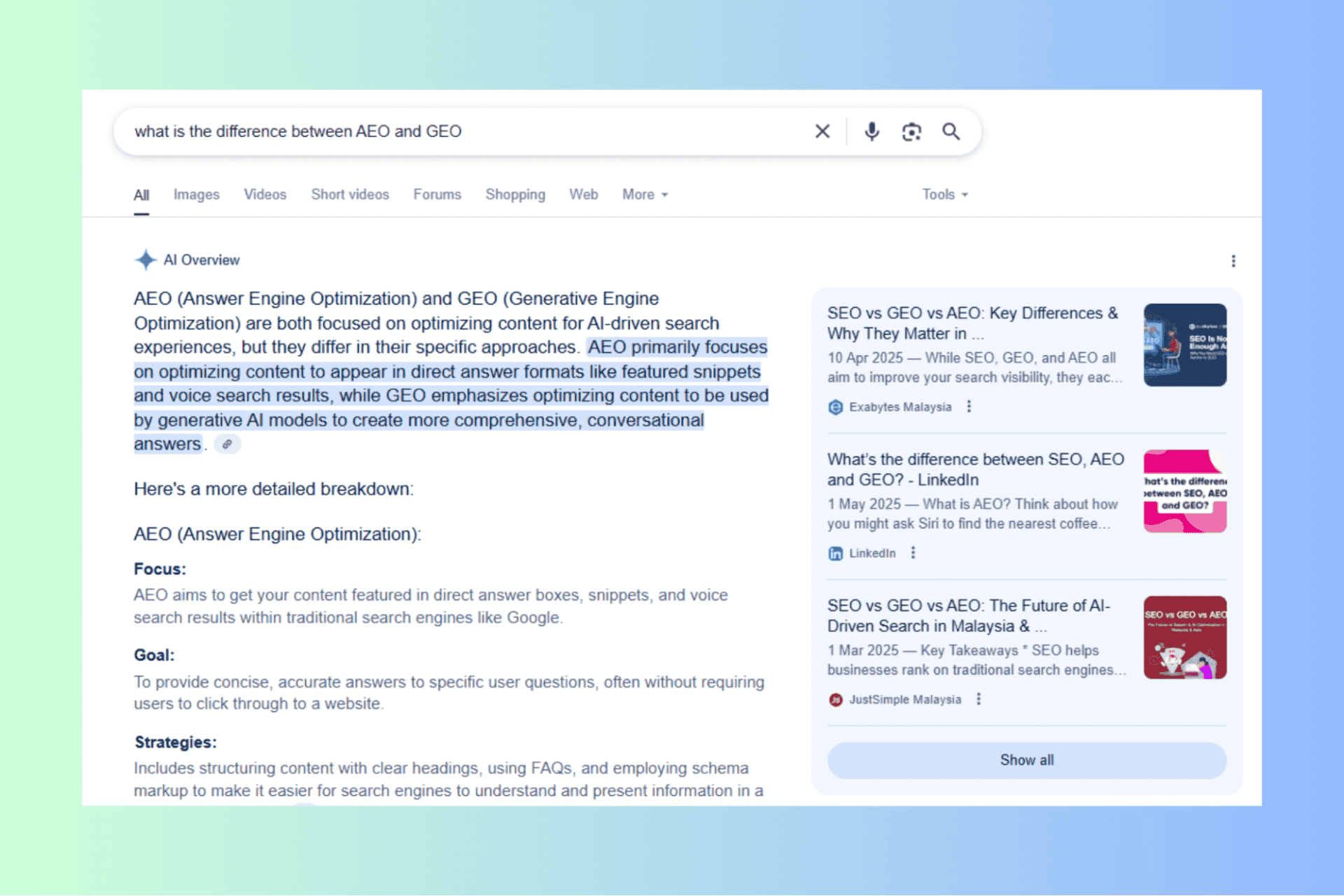
AEO is about making your content easily discoverable and ready for search engines to extract as direct answers. This approach became essential as search engines evolved to answer queries directly through featured snippets, voice responses, and more recently, AI summaries. Each time you see a featured snippet on Google or hear a quick response from a voice assistant, that’s AEO at work.
The main objective is to provide information that is clear, structured, and concise, so users get instant answers to their questions. With the recent addition of AI-generated summaries in search results, optimizing for direct answers has become even more crucial, as research shows these summaries alone can reduce clicks by 34.5% for informational inquiries.
However, this shift isn’t just about lost traffic; it’s about adapting to how users now consume information across different search features and formats.
Key elements of AEO include:
- Organizing content with FAQs and Q&A formats
- Using schema markup to help search engines interpret your information
- Writing brief, factual summaries
- Optimizing for voice search and zero-click results, where answers appear directly on the search page
AEO is especially important for brands aiming to connect with users who want fast, reliable answers, even when users don’t click through to your website. In short, AEO is about enabling search engines to find and deliver your answers quickly and accurately.
What is GEO (Generative Engine Optimization)?
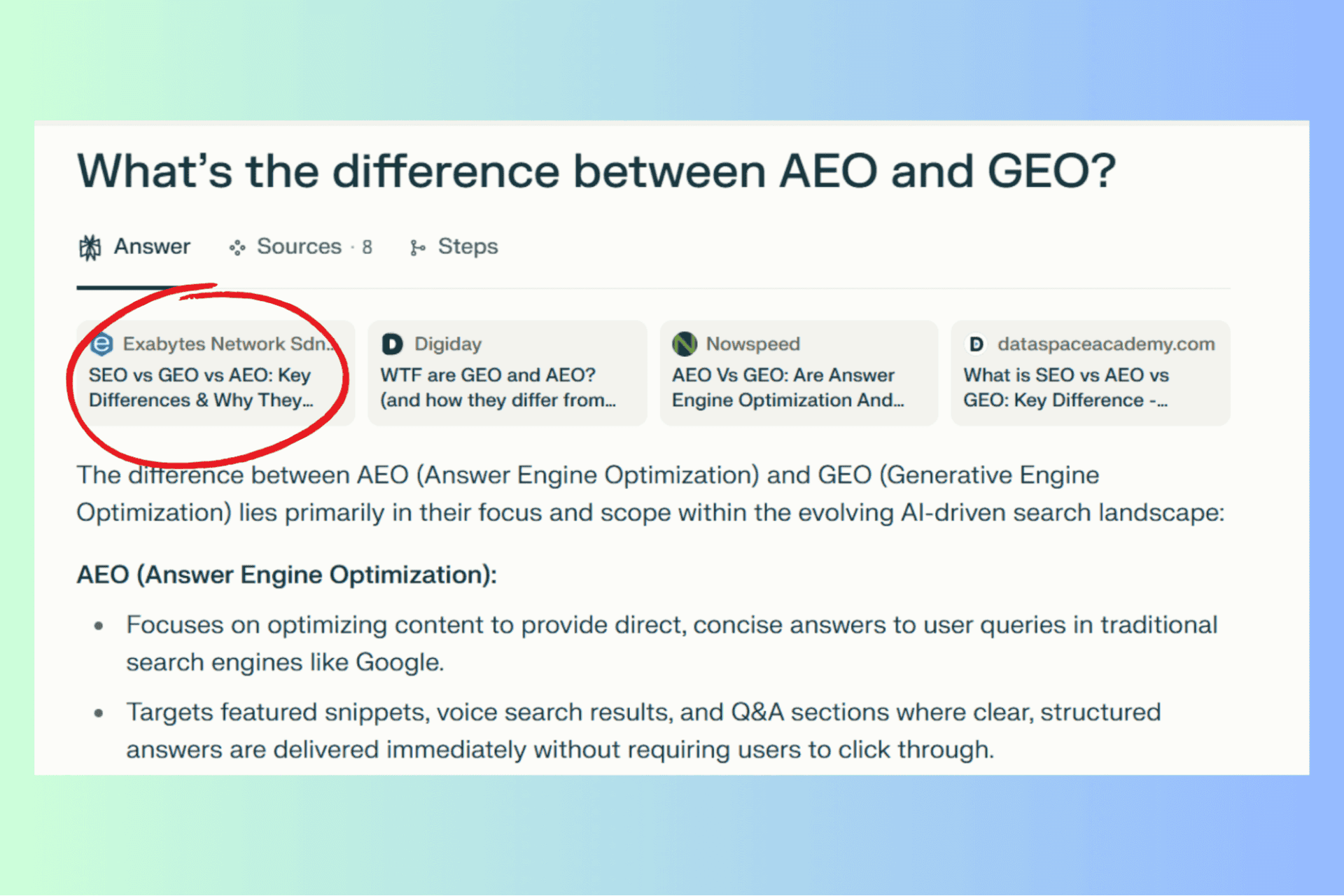
GEO takes optimization a step further. It focuses on making your content discoverable and trustworthy for AI-powered engines like ChatGPT, Google’s SGE, Gemini, and Perplexity, that generate answers by pulling information from across the web. According to Semrush, ChatGPT’s weekly active users grew eightfold between October 2023 and April 2025, now surpassing 800 million. Google has also begun rolling out AI Mode, which offers a ChatGPT-like experience and can fully replace the traditional search results page.
Looking ahead, Semrush projects that AI search visitors will surpass traditional search visitors by 2028. Even more compelling, the average AI search visitor is 4.4 times as valuable in terms of conversion rate compared to a traditional organic search visitor. This rapid evolution underscores why GEO is crucial for ensuring your brand is cited, summarized, and recommended by generative AI systems.
Key elements of GEO:
- Comprehensive, in-depth content that covers topics holistically
- Clear entity recognition (your brand, products, and experts are easily identifiable)
- Building digital authority through credible sources and mentions
- Ensuring your content is accessible and indexable by AI engines (not hidden behind logins or heavy JavaScript)
GEO is crucial for businesses that want to be referenced in AI-generated overviews, summaries, and conversational search results, especially as these platforms become more popular in Malaysia and worldwide. In short, it’s not just about being found—it’s about making your content genuinely useful and relevant when an AI engine crafts its answer.
AEO vs GEO: The Main Differences
| Feature | AEO (Answer Engine Optimization) | GEO (Generative Engine Optimization) |
| Main Goal | Direct answers in searchresults | Inclusion in AI-generatedsummaries |
| Platform Focus | Google(featured snippets, knowledge panels), Bing(snippets, voice), etc | ChatGPT, SGE, Gemini, Perplexity, etc. |
| Content Style | Concise, Q&A, snippet-friendly | Comprehensive, context-rich, entity-based |
| OptimizationTactics | FAQ schema, short answers | Entity optimization, credibility, depth |
| Measurement | Snippet wins, voice presence | AI citations, brand mentions inLLMs |
Both AEO and GEO are rooted in the same principle: content now needs to be optimized for AI engines, not just traditional search engines. As the way people search continues to evolve, these strategies are simply responses to different stages of that evolution.
- AEO emerged with AI-assisted search, like snippets, voice, and structured data, as a reaction to the rise of zero-click searches and direct answers in the SERP.
- GEO is a response to the new wave of AI-generated search—think chatbots, conversational interfaces, and retrieval-augmented generation—where platforms like ChatGPT, Gemini, and Perplexity synthesize answers from multiple sources.
So, why do we keep hearing both terms if they’re so closely related? In many ways, it’s a branding thing. Marketers and industry leaders love to name and reframe trends to signal shifts in the landscape. AEO came first, but as generative AI exploded, GEO entered the conversation as a way to capture this new era, one where machines don’t just surface content, but actively generate new responses.
Ultimately, both AEO and GEO are about keeping up with how users interact with search. AEO focuses on optimizing for structured, answer-first interfaces like voice assistants and featured snippets, while GEO reflects the move to conversational, synthesized answers. But at their core, you’re still optimizing for the same system: a machine trying to understand your content.
Why Your Business Needs Both AEO and GEO

Most digital marketing experts agree that AEO and GEO are not mutually exclusive. In fact, the best strategies blend both to ensure your content is accessible, authoritative, and optimized for both traditional search engines and AI-driven answer engines. As up to 47% of searches now feature AI-generated overviews, Businesses should invest in both AEO and GEO strategies to:
- Capture users seeking instant answers (AEO)
- Build authority and trust with AI-powered engines (GEO)
- Future-proof their digital marketing as search evolves
Combining AEO and GEO prepared your brand to stand out. This dual strategy keeps your business visible and relevant in an increasingly AI-driven world.
How to Get Started with AEO & GEO
Lead with Clear, Direct Answers
Start each page or section with a concise summary or takeaway. Use TL;DR boxes, bolded key points, or summary bullets at the top. Frame important questions as subheadings and follow them with short, direct answers. This approach ensures both users and AI engines can quickly find and quote your main points.
Structure and Semantic Richness
Data from Ahrefs (Feb 2025) shows ~63% of sites studied received traffic from AI chatbots. Therefore, use descriptive headings, bullet points, lists, and tables to organize information. Implement structured data like FAQ schema and markup to help search engines understand your content. Write in natural, conversational language and include synonyms and related terms for context. This helps both traditional crawlers and generative AI models interpret your content accurately.
Comprehensive Coverage and Depth
Go beyond surface-level answers. Address the main query and related follow-up questions, covering the what, why, how, pros/cons, and real-world examples. Organize information logically with subheadings so both readers and AI can easily follow the flow. Aim for your page to be the definitive source on the topic.
Content Authority, Credibility, and Trust
Cite reputable sources, link to authoritative domains, and include author bios with credentials. Use internal links to build topical authority and update your content regularly. Demonstrate expertise with expert quotes, data citations, and social proof like testimonials or notable mentions. A research paper indicates that adding relevant statistics, quotations, and citations can boost content visibility in generative engines by up to 40%, according to Search Engine Land.
Entity Optimization
Ensure your brand, products, and experts are clearly identified using structured data and consistent naming across your website and third-party platforms. Associate your content with high-authority sources, both internally and externally.
Diversify Your Digital Footprint
AI engines reference content from across the web. Repurpose your core content for platforms like LinkedIn, Reddit, YouTube, and Quora. Share insights on high-authority forums and maintain consistent branding. The broader your digital presence, the more likely AI engines are to recognize and reference your brand.
By following these best practices, you’ll position your content to stand out.
Preparing Your Brand for Every Type of Search

The difference between AEO and GEO is subtle, but the impact on your digital strategy is significant. Optimizing for both means your brand is prepared for every type of search, traditional or AI-powered.
At Cleverus, we leverage industry-leading SEO and digital marketing expertise to help your business stand out in this new era. From technical optimization to content authority, our team is ready to help you capture attention and build trust across every platform. Book your free consultation here today to start your journey toward AI-ready search success.